Management quota and NRI quota are not the same thing; however, they get used interchangeably in almost every consultant pitch and parent WhatsApp group.
The difference is that one decides how a private college fills its own seats. The other decides who's even allowed to apply through a separate, NRI-linked route. Mixing the two up is exactly how families end up talking to the wrong people about the wrong seats.
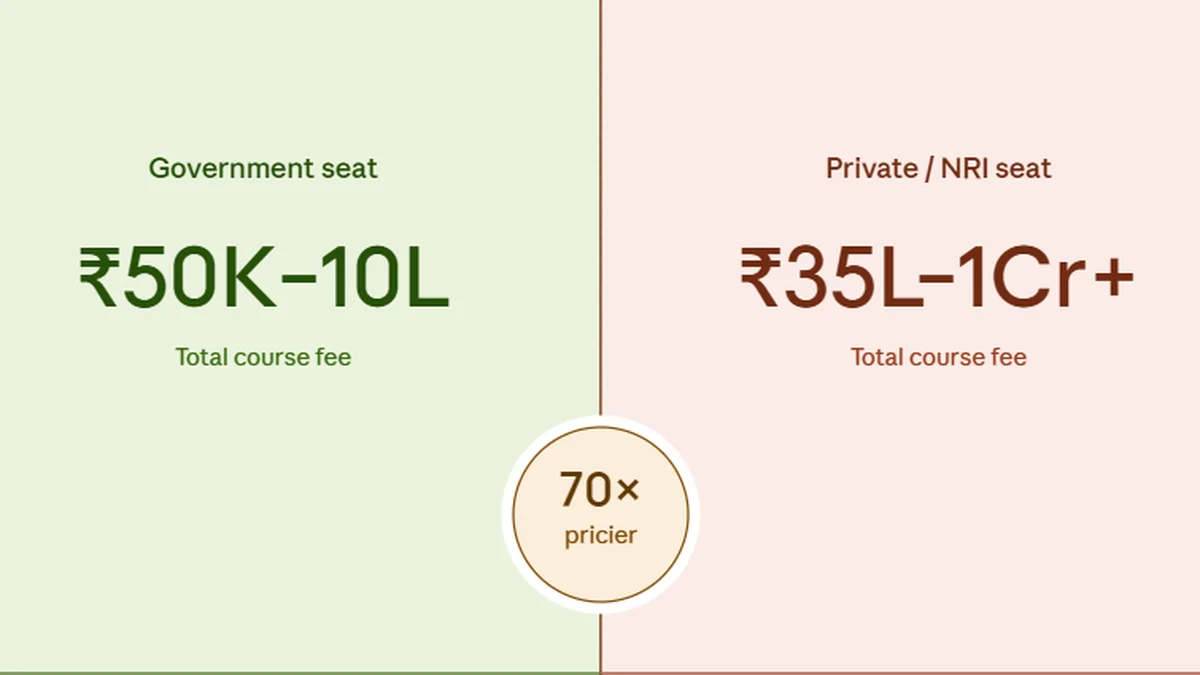
That single decision can be worth a ₹1 crore difference in the actual cost of your MBBS. Read the complete article before you commit to either.
Interactive Tool
NEET Rank Predictor
Estimate your expected All India Rank (AIR) and percentile using historical NTA data.
Management quota refers to a portion of seats in private and deemed medical colleges (Colleges with their own standards) that the college's own management fills directly, rather than through the centralised merit-based counselling that decides government seats.
Most private and deemed colleges set aside roughly 15% of their seats this way, though the exact share shifts by state. Tamil Nadu, for instance, splits its private-college seats into 50% state quota, 35% management quota, and 15% NRI quota, which is a noticeably different mix from the national norm.
One fact is constantly missed: government medical colleges do not have management quota seats at all. It exists only in private and deemed institutions. If anyone claims to offer a "government college management quota seat," that claim alone is a red flag.
NEET is still completely mandatory here. A 2016 Supreme Court ruling, since written into NMC regulation, removed any path to MBBS admission, management quota included, without a qualifying NEET score.
The cutoff for management quota seats typically mirrors NTA's regular qualifying percentile (40th for reserved categories, 50th for general), but in practice, the actual score that gets you in is usually well below what a government seat requires, and therefore, these seats come with a much higher fee attached.
Who Is Eligible for the NRI Quota in NEET
So what is the NRI quota in NEET, exactly? It's a separate reservation, usually 15% of seats in private and deemed colleges, and in a handful of government colleges in specific states like Rajasthan, Haryana, Punjab, and Gujarat, set aside for candidates connected to Non-Resident Indian status.
There are two distinct ways to qualify, and conflating them is the single most common mistake families make:
Genuine NRI candidates: the student themselves (or their parent) has lived abroad for an extended period, typically holding NRI, OCI, or PIO status, with documents like a foreign work/residence visa and an NRI certificate from the Indian Embassy in that country.
NRI-sponsored candidates: the student is an Indian resident with no NRI status themselves, but a close relative abroad, most commonly a parent, but rules vary by college and can extend to siblings, grandparents, aunts, or uncles, formally sponsors their education and bears the entire fee.
Sponsorship isn't a verbal arrangement. Colleges require a notarised sponsorship affidavit (often on stamp paper), an embassy-attested certificate proving the sponsor's NRI status, and documented proof of the actual blood relationship; a "friend" sponsoring a candidate, no matter how willing, does not qualify.
And the same rule from the management quota applies here too: NEET is mandatory for the NRI quota, with zero exceptions, regardless of nationality, passport, or how the fee is paid.
Interactive Tool: Am I Eligible for the NEET NRI Quota?
Walk through the official criteria to check your eligibility instantly.
1. Do you (the candidate) or your parents hold a foreign citizenship (OCI/PIO) or reside abroad as Non-Resident Indians?
2. Do you have a first-degree blood relative (parent, sibling, grandparent, or real uncle/aunt) living abroad with valid NRI/OCI status?
3. Is this relative willing to sign a notarised sponsorship affidavit and provide embassy-attested relationship proof?
Eligible (Genuine NRI)
You qualify under the Genuine NRI candidate category. You hold foreign status (or your parent does), which means you can apply directly through the separate NRI merit pool using your official embassy-issued NRI certificates and visas.
Eligible (NRI-Sponsored)
You qualify under the NRI-Sponsored category. Although you are an Indian resident, your first-degree relative's notarised sponsorship and embassy-attested documents satisfy the MCC and state counselling requirements for NRI seats.
Ineligible for NRI Quota
Unfortunately, you do not meet the minimum requirements. You must either be a genuine NRI or be sponsored by a first-degree blood relative with official embassy documentation. Informal sponsorship by friends or distant relatives is rejected.
NEET Private College Fees
This is where the two quotas diverge sharply on cost. Based on fee data across multiple private and deemed medical colleges:
Seat Type
Typical Annual Fee
Typical Total Course Fee (5.5 yrs)
Private/deemed college: regular/state quota
₹6–25 lakh
₹35 lakh – ₹1.2 crore
Private/deemed college: management quota
₹2–22 lakh
₹20 lakh – ₹1 crore+
Private/deemed college: NRI quota
$20,000–$100,000+ (₹15 lakh–₹85 lakh+)
Often ₹1 crore or more
These ranges move a lot by state and by how sought-after the college is. Karnataka and Tamil Nadu, for example, have government-fixed fee caps for some private colleges specifically to stop runaway pricing, while a handful of deemed universities at the very top of the demand curve charge well beyond ₹1 crore total, NRI quota especially.
MBBS Fees After Clearing NEET in Government Colleges
Government colleges are a different universe entirely. Across central institutions and most state-run colleges, fees typically range as follows:
AIIMS sits at the extreme low end; its tuition runs to roughly ₹5000 to ₹7000 for the entire course (not per year, despite how that figure often gets misreported elsewhere), with hostel offered separately, subject to availability. A reader who actually holds an AIIMS Kalyani seat confirmed paying ₹5856 for the complete course, which is a useful reminder that this number is real, not just an aggregator estimate.
Most state government colleges land well above that: combined tuition, hostel, and mess together typically run ₹16,000 to ₹2.1 lakh a year, and most students finish the entire 5.5-year course, every cost included, somewhere between ₹50,000 and ₹10 lakh, depending heavily on the state and college.
A 2026 update worth knowing: NMC's April 7, 2026, notice now caps MBBS tuition billing at 4.5 academic years; colleges can no longer charge tuition for the internship year. Hostel and mess still run the full 5.5 years, since the intern is still on campus. The "Total Course Fee" figures in both tables above were calculated under the older 5.5-year tuition norm, so real totals going forward, especially for tuition-heavy private, management, and NRI seats, are likely to land somewhat lower. The rule is barely two months old, so don't be surprised if some colleges haven't fully adjusted their billing yet.
Input your annual fees to see the absolute savings under the new billing cap.
₹
₹
Total Tuition Saved (1.0 Year)₹ 15.00 Lakh
Old Billing Rule (5.5 yrs tuition):₹ 90.75 Lakh
New NMC Rule (4.5 yrs tuition):₹ 75.75 Lakh
Note: Tuition is capped at 4.5 academic years, while hostel and mess charges continue for the full 5.5 years.
What People Are Really Paying
Every number above comes from aggregated published sources. Here's something different, actual fees reported directly by people currently studying MBBS, collected through a short reader survey. The sample is still small (just over a dozen responses), so treat this as real anecdotes, not a verified average, but a few of them line up closely enough with each other to be genuinely useful:
Agartala Government Medical College, Tripura, State Quota: two separate readers, admitted in different years, both reported almost the same number, around ₹75,000 a year (₹60,000 tuition + ₹15,000 hostel for one; a flat ₹75,100 for the other). When two unrelated people land on nearly the same figure, that's about as close to confirmed as reader data gets.
NEIGRIHMS, Shillong: two readers here too, reporting 16.6k/year (+ 20k security deposit in 1st year) and ₹17,000 a year under North East Open Quota and All-India Quota respectively, close enough to trust as a genuine reflection of this institute's fee level.
NRS Medical College and Bankura Sammilani, West Bengal, State Quota: ₹9,000 and ₹9,166 a year, respectively, provide a real look at just how low West Bengal's state quota fees actually run.
NC Medical College, Panipat, Management Quota: one reader reported paying ₹82 lakh a year, far above the typical management-quota range covered earlier in this article. We're including it because it's a genuine report, not because it's representative, a reminder that management quota fees can swing wildly by college.
This needs to be said plainly: if anyone, an agent, a consultant, a college representative, offers a guaranteed MBBS seat without a qualifying NEET score, for a lump payment of ₹20–40 lakh "all-inclusive," that is fraud. There is no legal path to MBBS admission in India without NEET, under any quota, for any nationality.
The Supreme Court has ruled on this directly, and colleges caught circumventing it risk losing their recognition entirely. If you're approached this way, the safest move is to walk away and verify every claim directly through the college's official counselling notice or the state/MCC counselling website, never through cash payments or unofficial intermediaries.
Once you've actually cleared NEET, the realistic next step is running your raw score through our NEET Marks Calculator to know exactly where you stand before weighing a government seat against a private or NRI-quota option.
Frequently Asked Questions
Can the same candidate apply for both the management quota and NRI quota at the same college?
Generally, a candidate applies under whichever single category they actually qualify for (general merit, management, or NRI), not multiple at once for the same seat. Some colleges do allow you to register interest in more than one quota's counselling process, but you can only ultimately accept one seat.
Can I switch from the NRI quota to the general/state quota mid-counselling if I change my mind?
Not easily. NRI quota seats come from a separate seat matrix and counselling pool. Once you accept and report to an NRI quota seat, moving to a different quota usually means formally withdrawing first, forfeiting your security deposit, and re-entering general counselling in a later round, with no guarantee a seat will still be open by then.
What's the actual difference between a "private college" and a "deemed university"?
A deemed university is a single institution given university-like status by the UGC, letting it set its own courses and fees independently. A regular private college stays affiliated with a state university and is often subject to that state's fee-regulation committee.
Where can I actually report a suspected "guaranteed seat" scam?
Complaints can be filed with the National Medical Commission (NMC) or the relevant state directorate of medical education, and payment-related fraud specifically can be reported through India's official cybercrime reporting portal. Keep every message, receipt, and screenshot; they become essential evidence if the case needs to be pursued.